RETENTIS® for soils and substrates

With RETENTIS®, any soil and substrate becomes a highly efficient water and nutrient reservoir. Even small additions improve the structure, increase moisture retention capacity, and ensure a consistent water and nutrient supply. Whether it's potting soil, container substrates, or raised bed substrates, RETENTIS® buffers dry periods, promotes healthy root growth, and reduces watering by up to 40%. At the same time, the wood-based granules act as a humus precursor, decomposing into nutrient-rich humus and permanently increasing soil fertility.

Icon Description
Icon Description
Icon Description

Typical applications & dosages

Soil/substrate mixtures:
10 – 20 g / liter of soil or substrate; Mix evenly with soil or substrate.

Root Protection Gel: Mix 0,5 - 0,7 kg with 10 liters of water. Wait 10-15 minutes until the granules have absorbed the liquid, stirring several times. Then immerse the roots for a few seconds.

Tip: Do not add RETENTIS® pure to the planting hole, but mix it with soil/substrate and mix well - this way the granules/gel are optimally distributed around the roots.

Pro tip:
Cover the treated substrate or area with about 2-3 cm of untreated soil or substrate - this way RETENTIS® remains under the surface and well protected.

Extra tip: Incorporate fertilizer at the same time! Mix your tried and tested fertilizer directly into the soil together with RETENTIS®. It binds the nutrients and releases them continuously over weeks to the plant roots - no washing out, no nutrient shock.

🧮 Calculate the exact requirement for your project right below with the RETENTIS®Calc Tools.

RETENTIS® im Wasserhalteversuch Torfreies Substrat vs. Torfsubstrat

RETENTIS® Water Retention Test – Peat-Free Substrate

In a laboratory test, the water retention capacity of a peat-free substrate was assessed with 2% (w/v) RETENTIS®, a control without additive, and 6% (w/v) bentonite. Over 110 minutes, 400 ml of water per liter of substrate were applied, equivalent to a precipitation event of approximately 35 mm (35 l/m²).

With RETENTIS®, the entire volume of applied water was retained in the substrate and no percolation occurred. In the control, approximately 120 ml percolated through the substrate, while 130 ml percolated with bentonite. RETENTIS® demonstrated a more than 40% higher water retention capacity compared to conventional substrate mixtures, substantially improving water availability in peat-free substrates.

Top: Comparison of Water Uptake of Different Substrates (Liters of water per liter of substrate)

  • Peat-free substrate shows the lowest water uptake at 0.32 l/l, retaining considerably less water than peat-based alternatives.
  • Conventional peat-based substrate reaches 0.37 l/l, approximately 20% higher than the peat-free substrate.
  • Peat-free substrate with 2% (w/v) RETENTIS® achieves the highest water uptake at 0.46 l/l.

Bottom: Comparison of Moisture Loss After 10 Days (Values in percent)

  • Peat-free substrate without a water-retaining additive loses up to 88% of its moisture.
  • Peat-based substrate shows a slightly lower but still high moisture loss of 75%.
  • Peat-free substrate with 2% (w/v) RETENTIS® reduces moisture loss to 55%, resulting in a sustainably improved water supply.
The experiment was conducted under standardized conditions using 1-liter pots with defined substrate volumes, fully saturated at the start. Water uptake and subsequent drying were recorded by gravimetric analysis throughout the experiment.

RETENTIS® Water Retention Test – Sand

In a laboratory test, the water retention capacity of quartz sand (particle size 0.5–2 mm) was evaluated with 2% (w/v) RETENTIS®, a control without additive, and 6% (w/v) bentonite. Over 140 minutes, 400 ml of water per liter of substrate were applied, corresponding to a precipitation event of approximately 35 mm (35 l/m²).

With RETENTIS®, only 100 ml of water percolated through the substrate, compared to approximately 200 ml in the control and 150 ml with bentonite. RETENTIS® therefore achieved a 50% higher water retention capacity than untreated sand and significantly improved water storage even in highly permeable substrates.

RETENTIS® im Wasserhalteversuch – Kommunales Pflanzsubstrat

In einem Versuch wurde die Wasserhaltefähigkeit eines kommunalen Pflanzsubstrats ohne Zusatz (Kontrolle) und mit 2 % (w/v) RETENTIS® verglichen (20 g RETENTIS® pro 1 Liter Substrat). Der Aufbau bestand aus einer mineralischen Mulchschicht (Splitt KK 4/6) sowie einem Staudensubstrat 0/8 mm als mineralisches
Kompost-Substratgemisch (80/20). Über 110 Minuten wurden 400 ml Wasser pro Liter Substrat appliziert (≈ 35 mm Niederschlag).

Ergebnis direkt nach der Bewässerung
Mit RETENTIS® lief deutlich weniger Wasser durch: In der Kontrolle versickerten 255 ml, mit RETENTIS® nur 130 ml – das sind 49 % weniger Durchsickern. Gleichzeitig blieb mehr Wasser im Substrat: Die Kontrolle speicherte 145 ml (36,25 %), mit RETENTIS® wurden 270 ml (67,5 %) gespeichert. Das sind 125 ml mehr pro Liter – also +86 % mehr gespeichertes Wasser.

Trocknung über Tage
Direkt nach dem Gießen (Tag 0) lagen 135 g Wasser in der
Kontrolle und 285 g in der RETENTIS®-Variante vor (+111 %). Nach 7 Tagen waren es 75 g (Kontrolle) bzw. 235 g (RETENTIS®). Das entspricht einer Trocknung von −44
% in der Kontrolle, aber nur −18 % mit RETENTIS®. Nach 14 Tagen verblieben in der Kontrolle nur noch 25 g (Trocknung −82 %), während die RETENTIS®-Variante noch 225 g enthielt (Trocknung −21 %). Damit war nach 14 Tagen mit RETENTIS® noch rund 79 % des Anfangswassers vorhanden – in der Kontrolle nur rund 19%.


Insgesamt speicherte das kommunale Pflanzsubstrat mit RETENTIS® +86 % mehr Wasser direkt nach der Bewässerung und hielt nach 14 Tagen noch rund 79 % des Anfangswassers – deutlich länger und stabiler verfügbar als die Kontrolle.

Kommunales Pflanzsubstrat | Vergleich

Oben: Wasser im Substrat im Standversuch (Angaben in l Wasser pro l Substrat)

  • Tag 0: Die Kontrolle hält 0,13 l/l, mit RETENTIS® werden 0,28 l/l erreicht – das sind +115 % (mehr als doppelt so viel).
  • Tag 7: Die Kontrolle fällt auf 0,07 l/l, mit RETENTIS® bleiben 0,23 l/l – das entspricht +229 % (rund dreimal so viel).
  • Tag 14: Die Kontrolle liegt nur noch bei 0,02 l/l, mit RETENTIS® sind es 0,22 l/l – das ist etwa 11-fach bzw. +1000 % mehr Wasser im System.

Unten: Trocknung des Substrates – Veränderung gegenüber Tag 0 (Angaben in %)

  • Nach 7 Tagen verliert die Kontrolle 44 % ihres Wassers, mit RETENTIS® sind es nur 18 %.
  • Nach 14 Tagen ist die Kontrolle um 82 % ausgetrocknet, mit RETENTIS® nur um 21 %.

Damit bleiben mit RETENTIS® nach 14 Tagen noch rund 79 % des Anfangswassers im System verfügbar (Kontrolle nur ~18 %).

Vergleich von verschiedenen Zuschalgstoffen

RETENTIS® zeigt im direkten Wasserhalteversuch die klar beste Wirkung: deutlich höhere Wasserspeicherung und deutlich weniger Durchsickern als Zeolith, Bentonit und Biochar.

  • Wasserspeicherung (Aufnahme): RETENTIS® speichert 85% des zugegebenen Wassers (425 ml von 500 ml).
    Zeolith und Biochar liegen bei 58%, Bentonit bei 60%.
    → Vorteil RETENTIS®: +25 bis +27 Prozentpunkte mehr gespeichertes Wasser.
    → Das entspricht rund +42–47% mehr Wasserspeicherung im Vergleich zu den Alternativen.
  • Durchsickern (Restflüssigkeit): Mit RETENTIS® sickern nur 75 ml durch.
    Zeolith und Biochar: 210 ml, Bentonit: 200 ml.
    → Vorteil RETENTIS®: ca. 62–64% weniger Durchsickern.

Kurzfazit: RETENTIS® speichert im Test am meisten Wasser (85%) und reduziert den Wasserverlust durch Durchsickern um rund zwei Drittel gegenüber Zeolith, Bentonit und Biochar.


Versuchsaufbau: 1 L torffreies Substrat je Variante, Bewässerung mit 500 ml Wasser. Aufwandmengen der Zuschlagstoffe: Zeolith 50 g/L, RETENTIS® 20 g/L (2 % w/v), Bentonit 60 g/L, Biochar 50 g/L.

Illustration showing how to use RETENTIS® water storage gel: 1. Mix gel with soil or substrate, 2. Plant, 3. Water.

Easy to use

Work RETENTIS® evenly into the dry soil. As a rule of thumb, use 20 g of granules per 1 liter of potting soil.

Three steps:
1 Mix · 2 Plant · 3 Water

Extra tip:
Work in fertilizer at the same time:

Mix your proven fertilizer directly into the soil with RETENTIS®. It binds the nutrients and releases them continuously to the plant roots over weeks – no leaching, no nutrient shock.
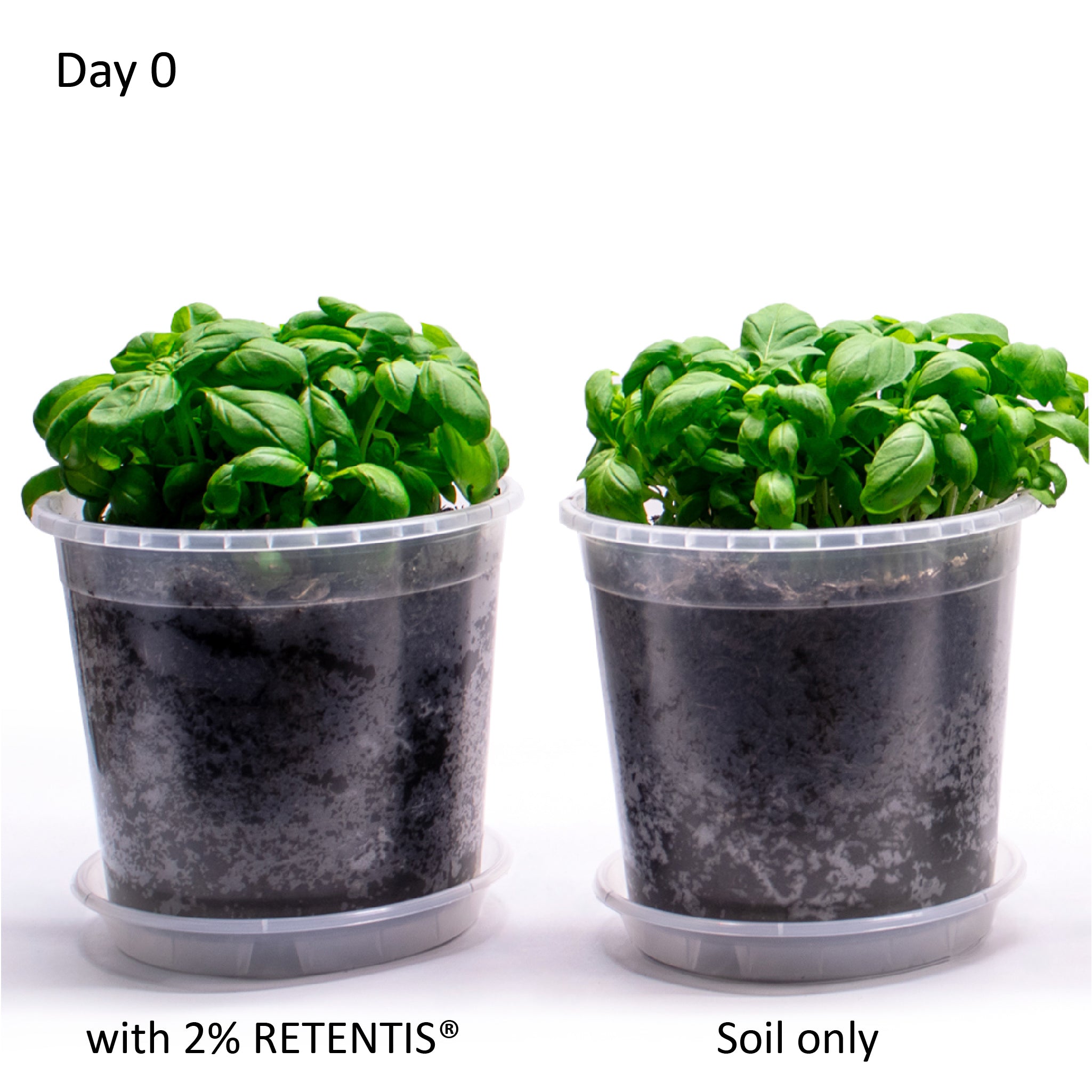
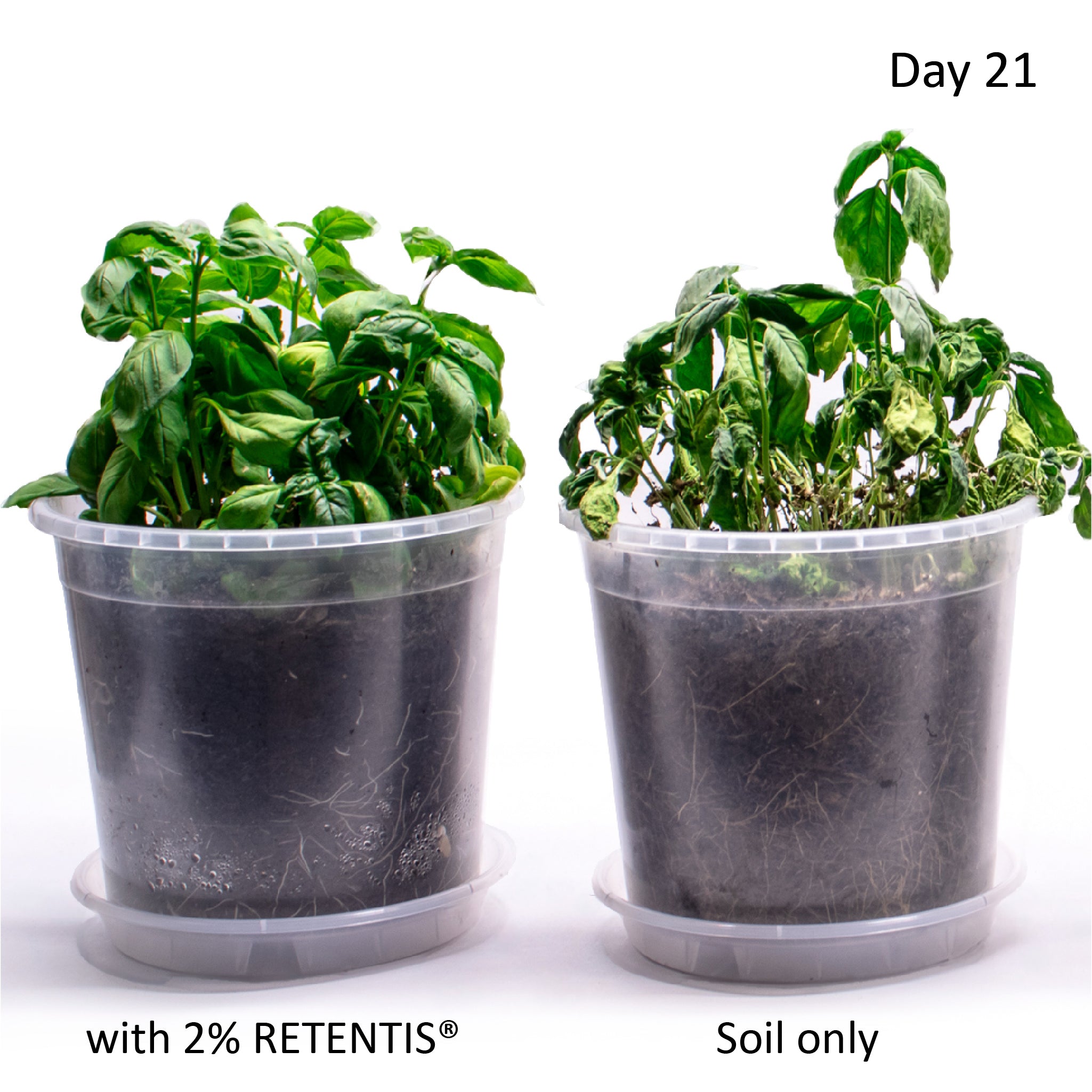
Before After

Why RETENTIS®

💧 Stores up to 10 liters of water per kilogram of granules and releases it back to the plants in dry conditions.
💦 Saves up to 40% irrigation water
⏳ Works in the soil for 3 – 5 years , completely without microplastics.
🍂 Promotes humus formation and soil structure.
⚖️ pH-neutral - RETENTIS® does not change the pH of the soil and can be mixed with other additives.
✅ is approved for organic farming .

Image: Basil after 3 weeks without watering, left with 2% RETENTIS®, right just soil. Move the slider and see the difference!


Further areas of application

Discover further applications of RETENTIS® and find the perfect solution for your project.